Showing posts with label New Orleans. Show all posts

Thursday, May 24, 2012

From Iron Railings to Wooden Shotguns: New Orleans to Baton Rouge

I was just in New Orleans during Jazz festival, and I got to thinking...
Everyone should see this! Repeatedly!

Architecture in New Orleans is an unusual European/Creole/American mix.
Of course, that makes sense, given its colorfully off-beat cultural history!
It's what draws a lot of tourists, and it sets the perfect backdrop for
 laid-back and stylish music, food, and people.
so...
Here's a great 2-part journey for you: 
First, tour the Architecture and Interiors of New Orleans. 
After you have sampled meals at Commander's Palace, Napoleon House, Nola, and Galatoire's, you will have experienced  many unique gastronomic experiences --  with plenty of Architectural and Interior Design eye candy to boot.
You will find Spanish architecture in the French Quarter, 
French-Creole buildings in the Faubourg-Marigny area,
 and American-Creole in the Lower St.Charles area,
up through the Uptown area. 
Then you must take in the old buildings and plantations 
along the River Road, between new Orleans and Baton Rouge. 
 You will see some differences in style which reflect each owner's 
(sometimes odd) personal and cultural influences: from Tuscany to the Far East.

Although no photo can do it justice, Here's what I'm talking about:
The French Quarter ( with its Spanish architecture!) :


Shotgun house, Tchopitoulas St:

updated cool interior

Typical New Orleans:

The preeminent Louisiana architect, A. Hayes Town, designed the 
most beautiful homes, primarily in his hometown, in Baton Rouge. 
His work honored the beauty and style of the old plantations:

Inside an "uptown" New Orleans home:

New Orleans:
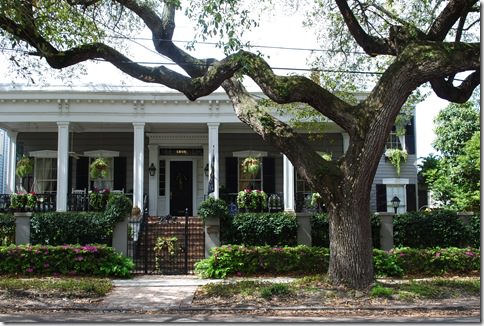
New Orleans:
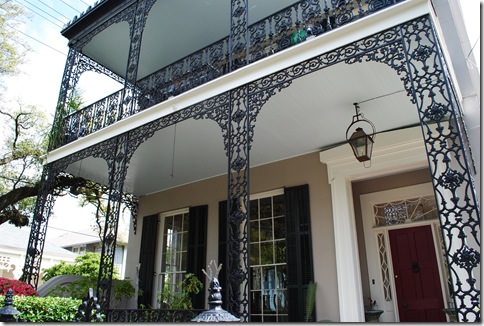
New Orleans:
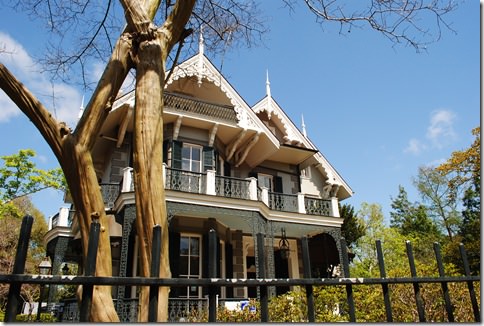

Another A. Hayes Town house in Baton Rouge:

But there's SO much more architectural delight outside of these cities~

From the City of New Orleans to the City of Baton Rouge,
there is a road that  leads past many historical sites.
It is called the River Road.
 It follows the Mississippi River for 70 miles, and as you drive along, 
you pass several  beautiful and historied plantations; among them:  
Houmas House, Destrehan Plantation, San Francisco Plantation, 
Nottoway Plantation, Oak Alley, and Oak Branch.
I highly recommend that rather than passing them by, you stop and take a tour.

Nottoway Plantation between Baton Rouge and New Orleans:

Built in 1858, Nottoway Plantation was one of the largest plantation homes in Louisiana. Nottoway was the centerpiece of a 7,000 acre sugarcane plantation. 
Originally it had 6,200 acres and 155 slaves.
Nottoway has 64 rooms done in an italianate style,
 and the grounds include several outbuildings and slave quarters. 

Oak Alley Plantation:


A not unusual sight along River Road, these 
dilapidated old buildings have their own appeal...

There is a wonderful book that I happened to come across
 at a friend's house that I have now ordered.
 I loved it and highly recommend it. It's called,
Vestiges of Grandeur: Plantations of Louisiana's River Road.
This book covers the architecture, interiors, and some history of the
70 mile stretch between New Orleans and Baton Rouge, Louisiana.
The photography is absolutely beautifully done. 


Get out your map, get in your car with a good camera, and don't forget your copy of 
Vestiges of Grandeur: Plantations of Louisiana's River Road !

Have a great day!
xo
Valerie


1-via 2-via  4-via 5- via 6-via 7-via 8-via 
9-via 10-via  11-via 12-via  13-via 14-via 
15-via 

Monday, March 19, 2012

New Orleans Folklore, Tradition, Style

Just a quick note about St. Joseph's Day in New Orleans...Sicilian Tradition in New Orleans:


Every March in  New Orleans, classified ads begin to appear in local papers from devout Catholics inviting the public at large to view their St. Joseph's Day altars.


 Altars can be anything from humble affairs, to elaborate arrays worthy of a top-flight caterer. Food from these altars is traditionally given away to the needy. 


Every year on March 19, thousands of locals and out-of-towners come to homes in New Orleans to enjoy the St. Joseph’s Day altars. 

Altars are displays constructed by Catholics to honor St. Joseph, whom they credit for sending rain to save the starving people of Sicily from a severe drought during the Middle Ages.

According to tradition, Sicily once experienced a failure of all crops other than  beans; the beans kept the population from starvation, and thanks were given to Saint Joseph. Broad beans subsequently became traditional on Saint Joseph's Day altars in many Italian communities. 


Some people carry a broad bean for good luck; some believe that if one carries a broad bean, one will never be without the essentials of life.

Thankful Sicilians offered their finest crops to feed the poor, a display of food and faith that continues today. Candles, religious figures, cakes, cookies, tarts, breads, memorials...
This delicious and beautiful custom, La Tavola di San Giuseppe, came to New Orleans in the 1800s as immigrants formed what is still the largest Sicilian population in the United States.
                                                                     

Elaborate displays, simple displays...our designs hold on to so much history for us!
Have a great day!
xo
Valerie

 via via via via via via via via via via via 
    

Tuesday, February 21, 2012

Mardi Gras Style, New Orleans Design

~ Inside New Orleans at Mardi Gras~
Ena! Ena!
Akout, Akout an deye
Chaque amoor fi
 nou wa na né
Chaque amoor fi na né

A Mardi Gras Indian costume and chant, spoken in
" Mobilian Jargon", an extinct Native American language consisting mostly of Choctaw and Chickasaw words and once used by Southeastern Indians, African Americans, and European settlers and their descendants in the Gulf Coast Region.

It's  Mardi Gras!  Party in New Orleans today, y'all !
 In honor of the day, and because I'm not there this year, 
I have  New Orleans design photos  and
New Orleans Interiors, Food, Facts, and Fashions:
New Orleans is a place where Africans (both slave and free) and American Indians shared their cultures and intermingled with European  ( mainly French and Spanish -- and Catholic) settlers. The result: a unique culture of music, food, architecture, and  Catholic Church-based celebrations 

Inside Nicholas Cage's New Orleans home:
     
Typical New Orleans courtyard:

Bars have no closing hour.
The food can be spicy.
Music is pulsating almost everywhere. 
The locals talk funny but seldom have southern accents.
They have a Saint Patrick's Day parade, Mardi Gras parades, Italian and French bakeries, people selling delicious sweet potato pies out of the baskets on their bikes...

    Delicious Beignets at Cafe du Monde~


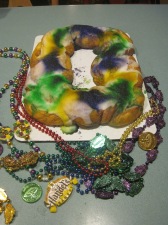
        King Cake (yum) + King Cake Parties 
        given by the one who found "the baby":


In a gorgeous New Orleans home:

Come for a visit, but get your itinerary from the locals. Bourbon Street is NOT what the city is all about.
You will meet Italian fresh produce dealers,  you will see century-old Catholic, Lutheran, Greek Orthodox  churches and Jewish temples. 
You will pass near African American store-front churches.
You can try some of the soul food restaurants. 
You will hear the unique NewOlreans accent, and the lilt of Spanish spoken in the streets. 
Colonnaded houses, a whiff of jasmine blossoms, grits and cornbread on fine dinner menus...
New Orleans is a foreign place, more a European than an American city.
It is a very different place with a very peculiar history.


Try to catch his band, The New Orleans Suspects, among many others. 
The band  performs to packed houses all over the country, but their home is
 New Orleans,and you can hear  that in the music.  Their schedule is here.


The Mardi Gras Balls range from Funky to Fabulous


LESSEZ LES BONS TEMPS ROULEZ, Y'ALL!
(Let the Good Times Roll!)
xo
Valerie


1-via 2-via 3-via 4-via 5-via
 6-via 7-via 8-via 9-via